
Nasal Airway Lumen-on-Chip


Overview
The human nasal airway is the first line of defense against airborne pathogens, and it is often the site of debilitating disorders such as asthma and rhinitis. Physiologically relevant models of the nasal airway are essential to understanding how these diseases develop, but many current models lack important dynamic conditions (such as breathing) which affect cellular function. Our nasal airway-on-chip platform can mimic the breathing airway. Using this dynamic platform, we can study how airflow affects cell behavior and investigate how healthy and diseased nasal airways are impacted by airborne particulates. AirLOC allows researchers to study respiratory functions and diseases in a lab setting by simulating realistic nasal airflow and blood-like conditions. This enables detailed investigation of respiratory interactions, drug responses, and disease progression in a controlled and physiologically relevant environment, reducing reliance on animal models.
Key Benefits

Dynamic Breathing Simulation
Captures airflow-dependent biological responses not possible in static cultures.

Respiratory Disease Modeling
Enables realistic modeling of asthma and airway inflammation.

Aerosol & Pollutant Testing
Supports controlled exposure to airborne particulates and therapeutics.

Barrier Function Studies
Allows investigation of mucus production and epithelial integrity.
Model Overview
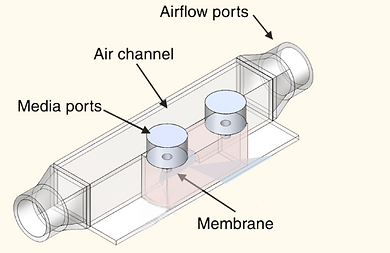
AirLOC consists of a microfluidic system where human nasal epithelial cells are cultured along a membrane that separates an air channel from a liquid channel. This setup maintains an air-liquid interface, which is essential for proper epithelial differentiation and mucus production.The system introduces bidirectional airflow, mimicking inhalation and exhalation, allowing researchers to study how shear stress and airflow patterns influence cellular responses. Integrated aerosolization capabilities enable controlled delivery of particles or drugs directly into the airway channel.Cells form tight junctions and produce mucus, recreating key features of the in vivo nasal environment, including barrier integrity and defense mechanisms.

Validation


AirLOC has been validated using primary human nasal epithelial cells, demonstrating successful cell growth, differentiation, and mucus production—key indicators of functional airway tissue.Fluorescent imaging confirms the presence of tight junction proteins (ZO-1) and mucus markers (MUC5AC), verifying the formation of a functional epithelial barrier consistent with in vivo physiology.Comparative studies between healthy and diseased (asthmatic) models show distinct differences in cellular behavior and mucus expression, supporting its use in disease modeling.
Airflow simulations and experimental measurements verify that the system reproduces physiological breathing conditions, while biocompatibility testing confirms long-term cell viability and function.


Publications


Our Partners